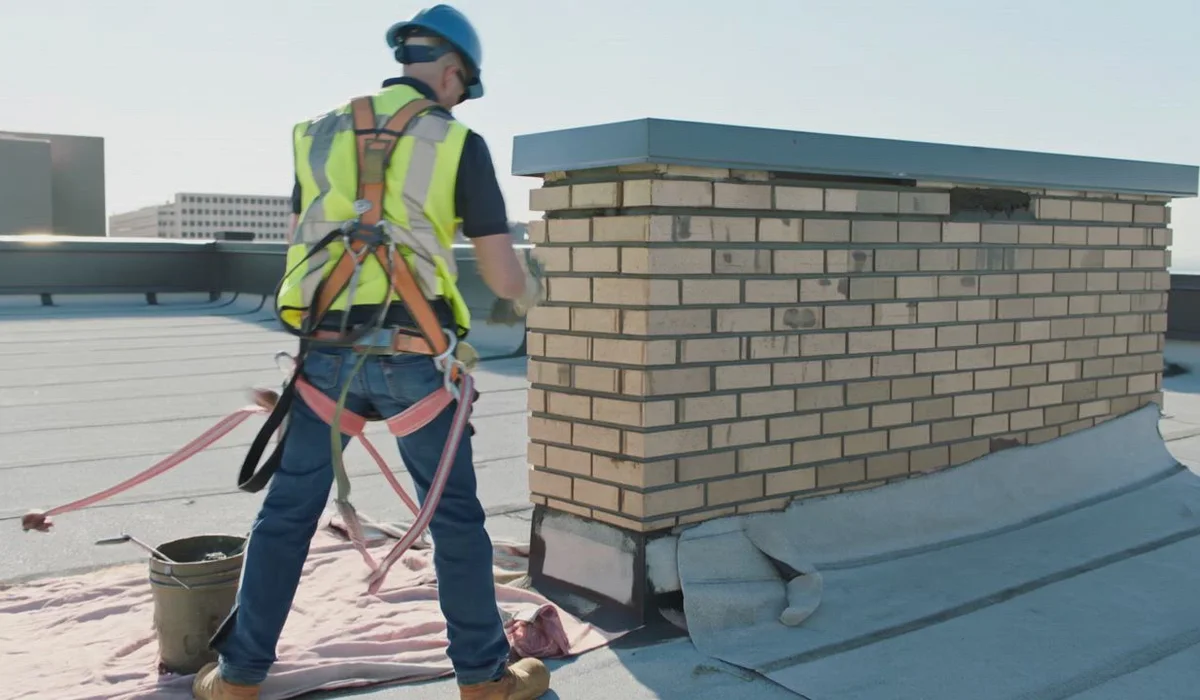
Commercial waterproofing starts by finding the water path
Commercial chimney waterproofing should identify whether water is entering through masonry, crown cracks, open joints, cap or chase cover failure, flashing, or another roofline transition before a treatment is selected.
Commercial chimney waterproofing should not begin with a coating. It should begin with the water path. If the leak is coming from failed flashing, a cracked crown, an exposed opening, or a rusted chase cover, surface treatment alone will not solve the issue.
Water-Entry Sources We Review
Crown cracks, missing wash, and open top-side joints
Missing, loose, or poorly fitted chimney caps
Rusted chase covers, open seams, and ponding water
Failed step flashing, counter flashing, or roof integration
Soft mortar, spalling brick, or open masonry joints
Commercial Risk
Water entry can become tenant complaints, ceiling damage, roof damage, masonry decay, or insurance questions. A written scope helps the property team handle the source instead of repeating temporary patching.
Repair Before Prevention
Waterproofing is strongest after the entry source is corrected. The scope should state which defects need repair first and which protective work makes sense afterward.

Water Path
First Question
Roofline
Review Area
Written Scope
Repair Sequence
Estimate Logic
What Changes a Waterproofing Estimate
Waterproofing scope changes with the source of entry, masonry condition, crown and cap condition, roof access, flashing details, and whether repairs are needed before treatment.
Masonry absorption, open joints, crown cracks, or cap failure
Flashing and roof-chimney transition condition
Chase cover rust, ponding water, or open seams
Access, height, working area, and documentation requirements
What We Put in Writing
Scope
Clear explanation of the issue, the proposed repair, and the access needed before work begins.
Materials
Named materials and standards where they matter, including NFPA 211 inspection scope and ASTM C270 mortar matching.
Documentation
Estimate notes, approved scope, and maintenance guidance for the chimney or fireplace system.
Should a commercial chimney be sealed before repair?
Not automatically. Open joints, cracks, failed flashing, or cap problems should be identified first because sealing can hide the wrong problem if the water path is not known.
What are common commercial chimney water-entry points?
Common points include crowns, caps, chase covers, flashing, mortar joints, porous masonry, and roofline transitions.
Can waterproofing be part of maintenance?
Yes. Once repairs are scoped correctly, water-entry prevention can be part of a planned maintenance path.
Commercial Chimney Waterproofing Service Areas
We provide professional commercial chimney waterproofing across the Chicagoland communities listed below.
Addison, IL
Antioch, IL
Arlington Heights, IL
Aurora, IL
Barrington, IL
Barrington Hills, IL
Bartlett, IL
Batavia, IL
Berwyn, IL
Brookfield, IL
Buffalo Grove, IL
Carol Stream, IL
Chicago, IL
Cicero, IL
Deerfield, IL
Des Plaines, IL
Downers Grove, IL
Elk Grove Village, IL
Elmhurst, IL
Evanston, IL
Forest Park, IL
Geneva, IL
Glen Ellyn, IL
Glencoe, IL
Glenview, IL
Grayslake, IL
Gurnee, IL
Hanover Park, IL
Highland Park, IL
Highwood, IL
Hinsdale, IL
Hoffman Estates, IL
Inverness, IL
Kenilworth, IL
La Grange, IL
Lake Bluff, IL
Lake Forest, IL
Lake Villa, IL
Libertyville, IL
Lincolnwood, IL
Lombard, IL
Long Grove, IL
Morton Grove, IL
Mount Prospect, IL
Mundelein, IL
Naperville, IL
Niles, IL
Norridge, IL
North Chicago, IL
Northbrook, IL
Northfield, IL
Oak Brook, IL
Oak Park, IL
Palatine, IL
Park Ridge, IL
River Forest, IL
Riverside, IL
Rolling Meadows, IL
Roselle, IL
Round Lake, IL
Schaumburg, IL
Skokie, IL
St. Charles, IL
Streamwood, IL
Vernon Hills, IL
Waukegan, IL
Western Springs, IL
Wheaton, IL
Wilmette, IL
Winnetka, IL
Need Commercial Chimney Waterproofing?
Request a water-entry review before sealing, coating, flashing, crown, cap, or chase cover work is selected.