

Chimney Inspection for Older North Shore Homes
North shore chimney inspection for Wilmette, Winnetka, Kenilworth, Glencoe, and Lake Forest: what the lakefront climate and older masonry demand.
The short version
- Water, failed mortar, cracked crowns, missing caps, and movement are masonry problems that need inspection before repair scope is chosen.
- Repair sequence matters: stop water entry, confirm structural condition, match mortar to the brick, then decide whether sealing, tuckpointing, repair, or rebuild is appropriate.
- Do not use city age, neighborhood age, or generic price ranges as a substitute for roof-level masonry findings.
Source check this article is cross-checked against IRC masonry chimney provisions, NPS repointing guidance, ASTM C270 mortar specification, and GLISA climate resources.
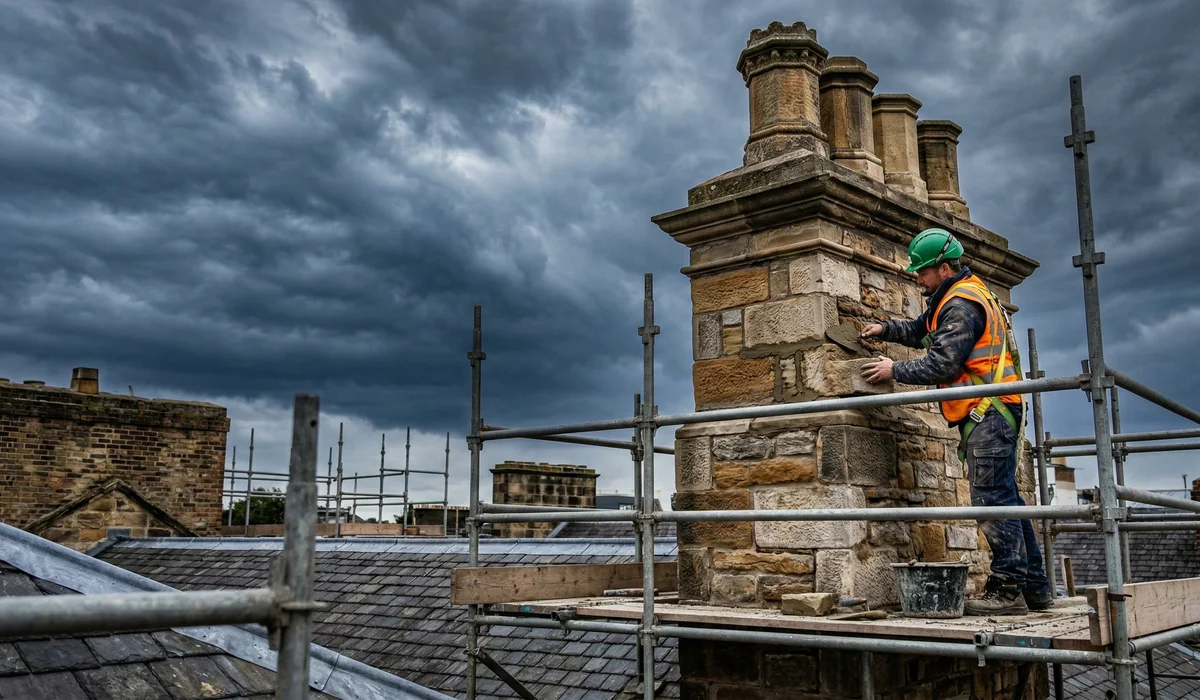
A north shore chimney inspection covers the same NFPA 211 framework as any chimney inspection in Chicagoland, but the combination of lakefront climate and older masonry stock makes the stakes higher and the findings more predictable. Chimneys in Wilmette, Winnetka, Kenilworth, Glencoe, Highland Park, and Lake Forest are subject to freeze-thaw exposure that noticeably exceeds the inland rate, and many are 80 to 130 years old. Both factors accelerate the typical chimney deterioration timeline.
NFPA 211 is the industry standard commonly used for annual inspection planning on chimneys in service. On the North Shore, that standard is not a suggestion. A chimney that goes two or three seasons without inspection on the lakefront is a chimney with a growing set of findings.
The Lakefront Climate Factor
The North Shore’s proximity to Lake Michigan creates a microclimate that matters for chimney maintenance. Lakefront and east-facing chimney exposures cycle through freeze-thaw noticeably more often than inland Cook County locations. The exact differential varies by position and distance from the shore, but the pattern is consistent: east-facing and north-facing chimney faces accumulate moisture from lake air and lake-effect precipitation, then cycle through freeze-thaw events that open mortar joints, crown cracks, and flashing gaps.
Water expands as it freezes. In a mortar joint that is hairline-cracked, that 9 percent expansion is enough to widen the crack. Repeat that process across dozens of freeze-thaw events in a single winter, and a minor finding from last year’s inspection becomes a material finding this year.
The Great Lakes Integrated Sciences and Assessments program (GLISA) documents the significance of Great Lakes freeze-thaw cycling as a factor in regional structural maintenance. For the North Shore, this is not an abstract consideration; it is the primary driver of the annual maintenance need.
What NFPA 211 Inspection Covers
NFPA 211 defines three inspection levels:
Level I covers visual inspection of readily accessible portions of the chimney interior and exterior, the firebox, and the accessible flue. For a chimney in continued service under unchanged conditions, Level I is the standard annual inspection.
Level II adds video scanning of the flue interior plus accessible attics, crawl spaces, and basements. It is required on a property sale or transfer, after a chimney fire, after a fuel-type or appliance change, or when a Level I finding warrants it. On North Shore homes that are being purchased, recently purchased, or that have not had a Level II in years, the video scan often reveals liner conditions that are not visible from the firebox.
Level III examines concealed areas, potentially requiring removal of building or chimney components. It is for suspected serious hazards identified in a Level I or Level II inspection.
The Level II inspection is particularly relevant on the North Shore because the housing stock age means liner deterioration is not a question of if but when. A clay tile liner in a chimney built in 1910, 1925, or 1940 has been through 80 to 115 heating seasons. Displaced tiles, cracked sections, and liner separation from the chimney wall are common findings on video scan that are invisible without it.
For a full overview of what inspection covers at each level, see the chimney inspection guide for Chicagoland homeowners and the level I vs level II inspection comparison.
Wilmette: Lakefront Masonry from the 1880s
Wilmette’s housing concentrates in the 1880s through 1940s, with substantial Italianate, Queen Anne, Tudor, and Prairie styles along the streets between Sheridan Road and Green Bay Road. These are chimneys that are 80 to 140 years old with original lime-rich mortar that has lost binder over that time.
Tuckpointing on Wilmette’s pre-1920 housing requires Type N mortar with a lime-rich formulation at ASTM C270 minimum compressive strength of 750 PSI. Using modern Portland-heavy mortar on the original soft brick causes the brick face to spall within five to ten years, which converts a routine repointing job into a brick replacement problem. Matching mortar to the original by sample is the standard approach for this era.
Wilmette’s lakefront masonry estate homes, the tall slender chimneys with decorative caps and corbels that extend well above the roofline, take maximum wind and lake moisture exposure. Crown rebuilds here often require structural repair below the crown, not just cap-and-seal work, because the upper courses have deteriorated further than the lower chimney.
Winnetka and Kenilworth: Architectural Significance and Strict Character
Both communities share the same lakefront freeze-thaw exposure. A crown rebuild on a Tudor Revival chimney in Kenilworth requires salvaging or matching the original brick to preserve the village’s architectural character. A new crown poured in a color or texture that diverges from the original masonry is visually conspicuous on properties where the chimney is a designed architectural element, not just a functional component.
For guidance on what crown repair involves, see the cracked chimney crown guide and the chimney cap and crown overview.
Glencoe: Compact Village, Maximum Lake Exposure
Glencoe’s housing concentrates in 1890s through 1940s Tudor Revival, Italianate, Georgian, and Prairie construction. The original chimneys in Glencoe’s oldest streets are 110 to 130 years old. Type N lime-rich mortar is required for any repointing. Modern Portland-heavy mortar will spall the historic brick within years, accelerating rather than resolving the deterioration.
Inspection findings in older Glencoe homes frequently include: mortar joint deterioration in the top three to six courses above the crown, crown cracking with visible water infiltration staining on the masonry below, and cap absence or failure. The combination of these three items is essentially universal on the 100-plus-year-old stock that has not had maintenance in the past decade.
Highland Park: A Larger City, a Wide Range of Ages
The older lakefront estate stock in Highland Park carries the same mortar matching requirement and the same accelerated freeze-thaw exposure as the rest of the North Shore. But Highland Park also has a substantial mid-century housing stock from the 1950s through 1980s, which presents a different inspection profile. These chimneys are in their second or third maintenance cycle: mortar joints that have lost binder, crowns that are cracked or have had amateur repairs, and flashing that is at or past the end of its service life.
For inspection before buying a Highland Park home with a fireplace, see the chimney inspection before buying a home guide.
Lake Forest: The Estate Standard
The inspection standard for Lake Forest estate chimneys is the same NFPA 211 framework, but the findings carry heavier consequence because the properties represent substantial architectural and financial value. An undetected liner crack in a Lake Forest estate chimney that leads to a chimney fire involves a home where damage is expensive and historically significant. Annual inspection and a Level II scan on any chimney over 50 years old is the appropriate standard here.
Lake Forest estates frequently have multiple chimneys serving different fireplaces, boiler stacks, and historical appliances. Inspection involves assessing each chimney independently and consolidating findings into a single property-level report.
What North Shore Inspections Typically Find
Drawing on the pattern across the North Shore housing stock rather than specific projects, the common findings on pre-WWII homes are:
Mortar joint deterioration in the exposed courses above the roofline, typically more pronounced on east-facing and north-facing chimney faces. Crown cracking ranging from hairline to through-thickness, with water infiltration staining on the masonry below the crown in many cases. Cap absence, cap corrosion, or cap displacement, which is the immediate cause of water entry into the flue. Flashing failure at the chimney-roof junction, often visible as interior staining near the chimney. Liner displacement or cracking found on Level II video scan on chimneys over 50 to 60 years old.
None of these findings are unusual on the North Shore. They reflect the age of the housing stock and the climate. They are also manageable if caught early by annual inspection. A chimney where all of these items are present simultaneously and have been developing for several seasons is a chimney with a larger repair scope than one where annual inspection caught each item individually.
Scheduling a North Shore Inspection
Delta - Chimney Repair and Services has been serving the North Shore and northwest suburbs since 1987, dispatching from our Park Ridge office with no subcontractors. We provide chimney inspection services for Wilmette, Winnetka, Kenilworth, and Lake Forest, along with the broader North Shore service area.
Inspection pricing should be confirmed in writing before scheduling. A written repair estimate needs an on-site assessment beyond the inspection.
Call (847) 685-1043 or visit our contact page to schedule your North Shore chimney inspection.
A lakefront chimney in Wilmette or Kenilworth sees the same annual inspection standard as every chimney in service, but the findings arrive faster.
Sources and Standards
- NFPA 211: Standard for Chimneys, Fireplaces, Vents, and Solid Fuel-Burning Appliances National Fire Protection Association Defines the three chimney inspection levels and the annual inspection standard.
- ASTM C270: Standard Specification for Mortar for Unit Masonry ASTM International Mortar types and minimum compressive strengths used in chimney masonry repair.
- Great Lakes Freeze-Thaw Climate Data GLISA, University of Michigan Freeze-thaw cycle data for the Great Lakes region.
- Preservation Brief 2: Repointing Mortar Joints in Historic Masonry Buildings U.S. National Park Service Guidance on matching mortar for historic and soft-brick chimney repair.
- International Residential Code, Section R1003: Masonry Chimneys International Code Council Code provisions specific to masonry chimney construction.
Fact-checked against the above sources on 2026-05-21.
Pre-Heating-Season Inspection and Sweep (Aug-Oct)
Chimney work runs on a calendar. This is what matters for a Chicagoland home in the window you are reading this.
- The Annual Chimney Inspection: What It Covers NFPA 211's annual cadence means the inspection belongs before the first fire of the season, not after.
- Why Fall Is the Best Time to Schedule a Chimney Sweep Answers the exact timing question homeowners are searching right now, before appliances go back into daily use.
- Fall Chimney Checklist: Before You Light the First Fire A complete pre-season checklist for everything to confirm before heating season starts.
- Chicagoland Seasonal Chimney Inspection Timing: When to Book Chicagoland-specific timing guidance for when to book, tied to local weather patterns.
- Heating Season Chimney Safety for Chicagoland Confirms the flue is clear and the liner is sound before regular winter use begins.
- Holiday Fireplace Safety: Before You Light the Fire What to check before lighting the fire for holiday gatherings, when the fireplace sees its heaviest seasonal use.
- Carbon Monoxide and Your Chimney Carbon monoxide risk rises with active heating-season use; this covers how a chimney problem creates that risk.
- Chimney Fire: Warning Signs and Prevention Creosote accumulated over active winter use is the direct driver of chimney fire risk.
- Freeze-Thaw Damage: What January Does to Your Chimney Where winter's freeze-thaw cycling shows up as visible masonry damage each spring.
- Post-Winter Chimney Checklist for Chicagoland A structured checklist for what to look at once the freeze-thaw season has passed.
- Spring Chimney Inspection: Reading Winter's Damage The seasonal inspection built specifically around catching winter's damage before it worsens.
- Cracked Chimney Crown: Causes and Repair The crown takes the most direct freeze-thaw damage of any component; what a crack there actually means.
- Why Spring Is the Right Time to Rebuild a Chimney Mortar needs consistently warm temperatures to cure properly, which is why spring opens the rebuild season.
- Summer Is the Best Time for Major Chimney Work The case for why summer, not winter, is when masonry work should actually be scheduled.
- Chimney Masonry Repair: Brick, Mortar, and Crown The comprehensive masonry repair guide for the season when that work can actually be done correctly.
- Tuckpointing a Chimney: When Mortar Joints Fail Tuckpointing mortar needs the same curing conditions as a full rebuild, which is why it's a warm-season job too.
The inspection content answers what's wrong; this answers what it costs to have someone look.
Chimney Inspection FAQs
01 Why do North Shore chimneys need special attention at inspection?
02 What does a Level II chimney inspection add over a Level I?
03 How much does a chimney inspection cost on the North Shore?
04 What mortar should be used on a North Shore historic chimney?
05 Does the North Shore lakefront climate really affect chimney wear?
More Chimney Inspection Guides
Your Chimney Failed Inspection. What Happens Next?
A failed chimney inspection is a scope question, not a verdict. How to read the finding, what has to be fixed before you burn, and what can reasonably wait until spring.
Read article InspectionHow to Read a Chimney Inspection Report
What the levels, components, and terminology on a chimney inspection report actually mean, and the questions worth asking before you approve any work.
Read article Chimney InspectionOrphaned Water Heater: What a High-Efficiency Furnace Does to Your Chimney
When a high-efficiency furnace switches to PVC sidewall venting, the gas water heater is left alone on a flue sized for two appliances. Here is why that matters and what to do about it.
Read article Fireplace ServicesWood Stoves and Fireplace Inserts: What Your Chimney Has to Do
What a wood stove or insert needs from an existing masonry chimney: liner sizing set by the appliance, clearances, the block-off plate, and why a stub connector is not enough.
Read articleHave a Question About Your Chimney?
Documented condition, a plain explanation, and a recommended scope before any work.