
Summer Is the Best Time for Major Chimney Work
Summer chimney repair lets mortar cure properly, contractors are available, and you beat the fall rush. Here is why summer scheduling pays off.
Too Long To Read
- Water, failed mortar, cracked crowns, missing caps, and movement are masonry problems that need inspection before repair scope is chosen.
- Repair sequence matters: stop water entry, confirm structural condition, match mortar to the brick, then decide whether sealing, tuckpointing, repair, or rebuild is appropriate.
- Do not use city age, neighborhood age, or generic price ranges as a substitute for roof-level masonry findings.
- Source check: this article is cross-checked against IRC masonry chimney provisions, NPS repointing guidance, ASTM C270 mortar specification, and GLISA climate resources.
Summer is the best window for major chimney repair. Mortar needs warmth and dry conditions to cure properly, and the heating season creates a hard deadline: if the work is not done before late October in Chicagoland, you are either rushing it in marginal weather or waiting until spring. This post explains why June through August is the right time to schedule masonry chimney work, and what jobs are most important to get done before winter.
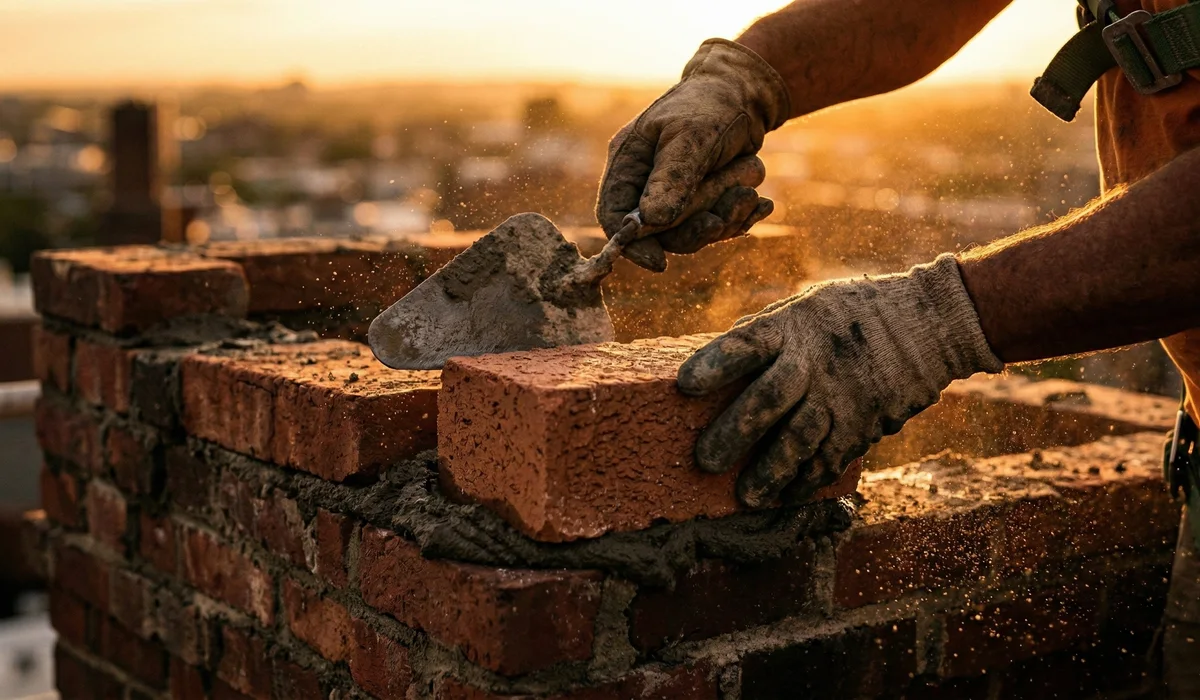
The argument is simple. Most significant chimney repairs, including tuckpointing, crown rebuilds, chimney liner work, and full or partial chimney rebuilds, involve masonry mortar that needs proper curing conditions. Mortar cures by hydration, and that process works best when temperatures are consistent and moisture is controlled. Summer provides both. The fall rush, when most people suddenly think about their chimneys, compresses contractor availability and pushes some jobs into conditions that are less than ideal.
What Summer Conditions Do for Chimney Mortar
Masonry mortar gains its strength through a curing process that takes weeks, not hours. During that time, the mortar is vulnerable to freezing, to premature drying, and to physical disturbance. Cold weather slows the hydration reaction; if temperatures drop below 40 degrees Fahrenheit before the mortar has reached adequate early strength, the reaction can stop entirely or produce a weak final product.
ASTM C270, the standard that governs mortar types and composition, defines minimum compressive strengths: Type N, the standard mortar for above-grade residential chimney work, must reach a minimum of 750 PSI. Type S reaches a minimum of 1,800 PSI for applications with higher lateral loads. These are the target strengths after full cure. Getting there reliably requires conditions that summer provides and late fall does not.
Crown rebuilds are the most curing-sensitive job on a chimney. The crown is a concrete or mortar cap that seals the masonry around the flue, and it sits fully exposed to the sky. A crown poured in July has roughly 90 days of warm, relatively dry weather before the first sustained freeze. A crown poured in October has a few weeks at best. The margin matters.
The Fall Rush and Why It Catches People Off Guard
The pattern repeats every year. Spring inspections find problems. Homeowners get estimates. Summer passes without action. October arrives and suddenly everyone is calling at once to get work done before the heating season. Contractor scheduling windows close fast in September and October.
The difference between a July job and a November job is not just the weather. It is the margin of error. A July tuckpointing job that needs an extra day of cure is fine. A November tuckpointing job that gets a hard freeze three days in is a problem.
Which Jobs Are Most Urgent in Summer
Not all chimney work carries the same urgency. Here is how to think about the priority order:
Crown rebuilds and crown sealing: A cracked crown is the fastest path to water damage in the masonry below. Water enters the crown crack, finds its way into the mortar joints below the crown course, and freezes. Each freeze-thaw cycle opens the path wider. Repeated freeze-thaw cycles each winter means a cracked crown left untreated is an actively deteriorating chimney from November through March. Crown work in summer gives the new material a full cure window before that cycle begins.
Tuckpointing: Failed mortar joints are a silent problem. Joints that have lost binder are not structurally compromised until water infiltration and freeze-thaw damage spall the adjacent brick. By the time spalling is visible, the underlying joint failure has usually been active for years. Repointing joints in summer stabilizes that process before the next freeze-thaw season.
Liner inspection and liner work: Any liner inspection finding that suggests cracking or deterioration should prompt action before heating season, not after. A cracked liner is a carbon monoxide and fire path. Summer is the right time for liner repair or chimney liner replacement because the appliances are not in use and the flue is cold and easy to inspect.
Chimney rebuilds: A full or partial chimney rebuild is the most disruptive scope of work on a chimney. It requires scaffolding, brick salvage or sourcing, and extended cure time for the new masonry. Summer is the only practical season for this work. See what a chimney rebuild involves for a breakdown of the scope.
The Case of Older Chicagoland Housing
Tuckpointing on a pre-1920 Oak Park chimney requires Type N mortar with a lime-rich formulation to match the original soft brick. Using a modern Portland-heavy mortar on historic Common Brick damages the brick face within five to ten years. Getting that work done in summer, when the mason can take time to match the mortar profile correctly without cold-weather pressure, produces better results than rushing it in October.
How Summer Scheduling Connects to the Inspection Finding
An annual NFPA 211 inspection, whether Level I or Level II, produces a written finding that describes the condition of every component the inspector can access. A Level I inspection covers readily accessible portions of the chimney and flue. A Level II inspection adds video scanning of the flue interior plus accessible attics, crawl spaces, and basements. NFPA 211 is the industry standard commonly used for annual inspection planning on chimneys in service.
If you received an inspection report this spring with findings, the right action is to schedule repair before the next heating season. The path from spring inspection to summer repair to fall heating-season start is a clean, low-stress sequence. The path from fall inspection to October repair window is compressed and expensive.
For post-winter chimney assessment and prioritization, the findings from a spring inspection are directly actionable in summer. For guidance on what the inspection covers and what the findings mean, see the annual chimney inspection overview.
Summer Is Also When Contractor Capacity Is Best
This point is often overlooked. Spring and fall are the busiest seasons for chimney companies, because those are the seasons when homeowners think about their fireplaces most. Summer has more scheduling flexibility, more technician availability, and shorter lead times from estimate to job start. A job that might have a three-week lead time in October might have a one-week lead time in July.
Writing everything down before work starts is standard practice at Delta. Scope, materials, and price are in writing before we mobilize. Summer scheduling gives more time to review the estimate, ask questions, and adjust scope if needed before the calendar pressure of heating season arrives.
For more on the relationship between chimney repair timing and long-term costs, see why chimney maintenance saves money long-term. For a full breakdown of what chimney repair encompasses, see our chimney repair service page.
Schedule Your Summer Chimney Repair
Delta - Chimney Repair and Services has been handling summer chimney repair across Chicagoland since 1987, dispatching from our Park Ridge office with no subcontractors. We serve Chicago, Oak Park, Evanston, and Lake Forest, along with the broader North Shore and northwest suburbs.
Call (847) 685-1043 or visit our contact page to schedule your on-site inspection and get a written estimate while summer scheduling windows are open.
The mortar in a chimney crown does not care what month you pour it, but your ability to get it done before winter does.
Sources and Standards
- NFPA 211: Standard for Chimneys, Fireplaces, Vents, and Solid Fuel-Burning Appliances National Fire Protection Association Defines the three chimney inspection levels and the annual inspection standard.
- ASTM C270: Standard Specification for Mortar for Unit Masonry ASTM International Mortar types and minimum compressive strengths used in chimney masonry repair.
- Great Lakes Freeze-Thaw Climate Data GLISA, University of Michigan Freeze-thaw cycle data for the Great Lakes region.
- International Residential Code, Chapter 10: Chimneys and Fireplaces International Code Council Residential code for chimney and fireplace construction and clearances.
- International Residential Code, Section R1003: Masonry Chimneys International Code Council Code provisions specific to masonry chimney construction.
- Preservation Brief 2: Repointing Mortar Joints in Historic Masonry Buildings U.S. National Park Service Guidance on matching mortar for historic and soft-brick chimney repair.
Fact-checked against the above sources on 2026-05-21.
Chimney Repair FAQs
01 Why is summer the best time to schedule chimney repair?
02 Can chimney tuckpointing be done in winter?
03 How far in advance should I schedule summer chimney work?
04 Does summer heat affect the chimney or the work?
05 What chimney work should I prioritize before heating season?
More Chimney Repair Guides
How Weather and Lake Michigan Affect Chimneys
Lake Michigan chimney damage on the North Shore follows predictable patterns. Learn how lakefront climate accelerates mortar failure, crown cracking, and liner deterioration.
Read article Chimney SafetyHow to Tell If Your Chimney Needs Immediate Attention
Chimney warning signs that require immediate action: smoke entry, carbon monoxide, active chimney fire, and structural failure. When to leave first and call emergency services.
Read article Chimney RepairChimney Liner Replacement: Process and Materials
Chimney liner replacement on Chicagoland homes: when it is needed, what material options exist, and how the process works from inspection through installation.
Read article Chimney RepairChimney Cap and Crown: Your Chimney's First Defense
Chimney cap and crown work together to keep water, animals, and debris out. How each component fails and what repair involves on Chicagoland masonry.
Read articleSchedule Before the Season Fills
Chicagoland inspection and repair slots fill before the heating-season rush.