
Fireplace Maintenance: The Annual Service Explained
Fireplace maintenance keeps your heating system safe and efficient. Learn what an annual service covers, why it matters, and what to expect in Chicagoland.
Too Long To Read
- Stop using the fireplace or appliance if there is smoke rollback, CO concern, fire damage, liner damage, blocked flue, unusual odor, or visible structural movement.
- Safety posts should lead to inspection and documentation, not experiments with repeated fires or temporary fixes.
- Treat the inspection result as the decision point for cleaning, repair, relining, or taking the system out of service.
- Source check: this article is cross-checked against CSIA inspection guidance, CDC carbon monoxide guidance, CPSC home heating safety guidance, and EPA wood-burning maintenance guidance.
Fireplace maintenance is the annual service that confirms your fireplace and chimney system are safe and functional before and after each heating season. It covers the firebox, damper, smoke chamber, flue, and exterior chimney components as a single system. Skipping annual maintenance does not mean the fireplace is fine - it means the condition is unknown.
For homeowners in Chicagoland, the combination of a long heating season, freeze-thaw cycling, and housing stock that spans a century of construction means the annual service often finds something worth addressing. The fireplace is one of the few heating systems in a home where the condition is genuinely invisible from the outside, and where a deterioration problem inside the flue can progress for years without any obvious symptom.
What Fireplace Maintenance Actually Covers
Annual fireplace maintenance is not a single-item task. It works through the system from the firebox at the bottom to the cap at the top. Under NFPA 211 standards, a Level I inspection covers all readily accessible portions of the system.
The firebox is the starting point. The inspection checks refractory brick and mortar panels for cracks, checks the rear wall and floor for deterioration, and looks for any gap or opening that would allow heat to reach the framing. Cast-iron fireboxes in older prefab units need examination for warping, cracking, and rust-through.
The damper gets a full open-and-close test. A damper that does not seat fully closed wastes energy all year. A damper that does not open fully restricts the draft when the fireplace is in use. Damper hardware corrodes and warps; the inspection confirms it operates correctly.
The smoke chamber sits directly above the firebox and below the flue. It is one of the most commonly deteriorated components in older fireplaces, because the stepped corbeled masonry that forms the chamber is exposed to thermal cycling and moisture every season. Loose mortar, spalling at the chamber walls, and incomplete parging all create surfaces that accumulate creosote and can contribute to a chimney fire.
Above the smoke chamber, the flue inspection under a Level I service covers the accessible visible portions. If there are findings that suggest tile cracks, displacement, or other structural issues, NFPA 211 standard language calls for escalating to a Level II inspection, which adds video scanning of the full flue interior.
The Creosote Component
Creosote is the combustion byproduct that accumulates on flue tile surfaces when wood-burning fireplaces are used. It exists in three stages, each progressively more difficult to remove and more hazardous.
Stage 1 creosote is light, flaky, and brushable. Annual sweeping handles it routinely. Stage 2 is hard, shiny, and tar-like - it requires specialized tools and more time to address. Stage 3 is glazed and hardened, with the highest chimney-fire risk; it often needs a chemical treatment before mechanical removal and may require full flue work if it has caused structural damage to the tiles.
The annual sweep removes Stage 1 buildup before it progresses. Homeowners who burn wood frequently, or who use the fireplace as a primary heat source during Chicagoland winters, should not extend sweeping intervals beyond a year. The heating season here runs from October through April in most years, which is a meaningful accumulation period for a regularly used fireplace.
Gas Fireplaces Need Maintenance Too
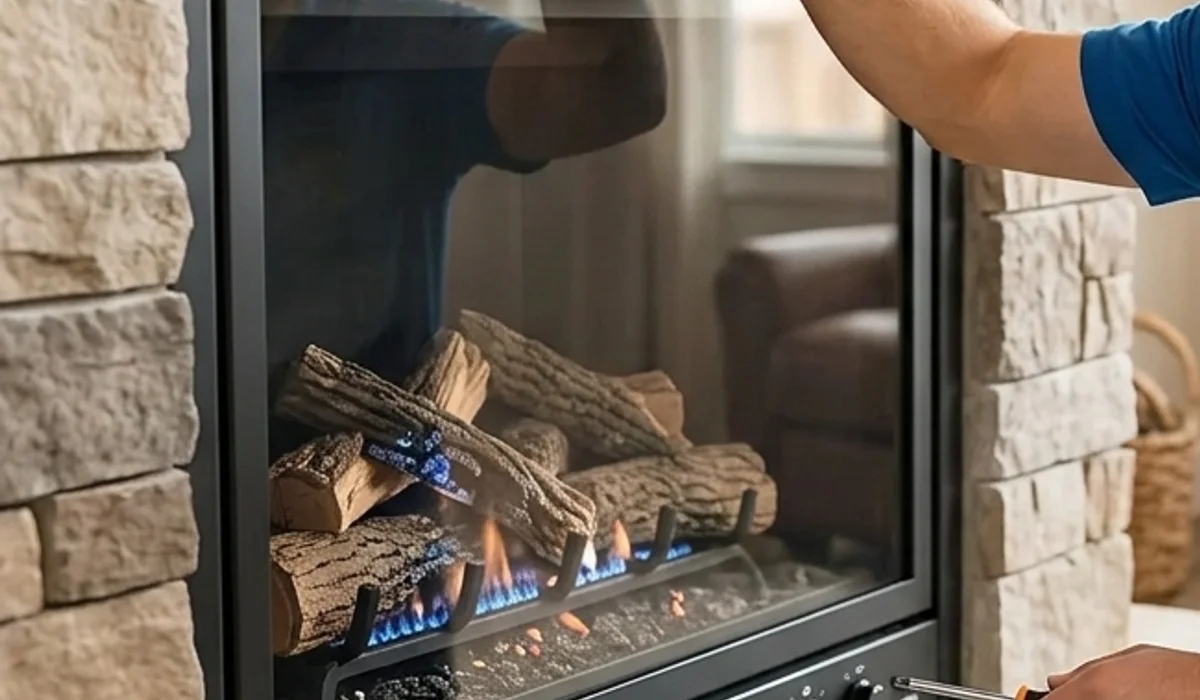
Gas fireplaces generate a different maintenance profile than wood-burning units, but they are not maintenance-free. The annual inspection for a gas fireplace covers the venting path under NFPA 54 standards, the firebox condition, the burner assembly and ignition system, and the glass panel gasket seal.
Gas combustion produces water vapor and carbon dioxide rather than creosote, but the venting components still deteriorate. Flue tiles crack from thermal cycling regardless of fuel type. The cap and crown are exposed to the same weather as any other chimney. A glass panel with a failed gasket allows combustion gases into the living space.
Burner and ignition service is the province of a licensed gas technician. Venting inspection and firebox condition assessment are chimney work. On a gas fireplace, both components need attention in the same service year.
What NFPA 211 Level II Means for Fireplace Maintenance
A Level I inspection is the annual standard when the chimney is in continued service under unchanged conditions. Level II is the standard scope when there has been a change: a new appliance or fuel type, a real estate transaction, evidence of a chimney fire, or when a Level I finding suggests deeper investigation.
Level II adds video scanning of the full flue interior, plus inspection of accessible attics, crawl spaces, and basements for clearance and chase integrity. For a fireplace that has not been inspected in several years, or for a home recently purchased, Level II is the appropriate starting point.
Spring Timing and What It Accomplishes
Scheduling fireplace maintenance in late winter or spring - after the heating season ends - accomplishes several things. First, it documents what the season produced: creosote accumulation, any cracking from thermal cycling, any water entry that showed up during winter. Second, it allows repair work to be scheduled and completed during spring and summer when weather conditions are favorable for masonry work and contractor availability is better.
Masonry work, including crown repairs, tuckpointing, and smoke chamber rebuilding, cures best at temperatures above 40 degrees Fahrenheit with no precipitation risk for several days. The window from April through October is substantially better than winter for this work. Discovering a cracked crown in March allows it to be repaired by May. Discovering it in October means scrambling before freeze-thaw conditions begin.
Our spring chimney inspection post covers the full range of post-winter damage patterns in more detail.
The Difference Between Maintenance and Repair
Annual maintenance is the inspection and cleaning that establishes condition. Repair is the work that addresses what the inspection finds. These are two different scopes and two different line items on an estimate.
A maintenance visit may find nothing that requires repair. It may find minor issues that can be addressed the same visit: a cap that has loosened, sealant at the crown that needs refreshing, a damper cable that needs adjustment. Or it may find structural issues that require a separate scheduled repair: a smoke chamber that needs parging, a crown that needs rebuilding, liner tiles that have shifted.
The maintenance visit produces a documented condition report. The repair scope comes from that report. Running the two together in a single call is efficient when findings are minor. Separating them is appropriate when the repair work requires materials, planning, and a full crew mobilization.
What the Smoke Chamber Finding Means
Smoke chamber deterioration is one of the more significant findings in older fireplaces, and one of the least visible from the homeowner’s side. The smoke chamber is the transition zone between the firebox and the flue, and in a traditional masonry fireplace it is formed by corbeled brick courses that step inward as they rise. That stepped geometry is structurally vulnerable.
Over time, the mortar joints in the corbeled courses loosen and the original smooth parging that was supposed to fill in the steps and create a smooth gas path erodes. Rough surfaces in the smoke chamber accumulate creosote faster than smooth surfaces, restrict draft, and create the conditions for a chimney fire if buildup ignites.
Smoke chamber parging, which involves applying a refractory compound to restore the smooth interior surface, is one of the more common maintenance-adjacent repairs on older fireplaces in our service area. For more on that specific repair, the smoke chamber parging post covers the process and when it is warranted.
Preparing the Fireplace for the Off-Season
After the final fire of the heating season, a few basic steps before the annual service visit improve the overall condition of the fireplace.
Remove accumulated ash from the firebox floor. Ash is hygroscopic, meaning it absorbs moisture from the air. A full ash bed sitting in the firebox over spring and summer creates a moisture environment that accelerates mortar deterioration at the firebox floor and lower walls. Leave approximately one inch of ash if you plan to use the fireplace again next season - it helps with combustion. Remove the rest.
Do not close the damper until the fire is fully cold and all embers are extinguished. Closing it too early traps combustion gases including carbon monoxide in the living space.
Leave the damper open during spring and summer if condensation is a concern. The open position allows the chimney to breathe and reduces the moisture buildup that produces chimney odor during warm, humid months.
For more on summer odor issues, see our fireplace odor post.
Scheduling Annual Fireplace Maintenance
Delta - Chimney Repair and Services has handled fireplace maintenance across the North Shore and northwest suburbs since 1987. We serve Morton Grove, Niles, Skokie, and Des Plaines, along with the full Chicagoland area from our Park Ridge office.
The annual service covers the full system from firebox to cap. We document findings, identify what requires repair, and provide a written scope before any work proceeds. Call (847) 685-1043 or use our contact form to schedule your service.
Related reading: the annual chimney inspection post covers what the NFPA 211 inspection framework covers at each level, and fireplace safety check outlines the safety-specific component checks that are part of every visit.
An annual service is not optional maintenance you can defer indefinitely - it is the baseline that confirms the fireplace is safe to use before you light the first fire of the season.
Sources and Standards
- NFPA 211: Standard for Chimneys, Fireplaces, Vents, and Solid Fuel-Burning Appliances National Fire Protection Association Defines the three chimney inspection levels and the annual inspection standard.
- NFPA 54: National Fuel Gas Code National Fire Protection Association Governs venting for gas appliances and gas fireplaces.
- International Residential Code, Chapter 10: Chimneys and Fireplaces International Code Council Residential code for chimney and fireplace construction and clearances.
- Chimney Safety Institute of America: Inspection and Sweep Standards Chimney Safety Institute of America Industry standards for chimney inspection and the value of certified technicians.
- CSIA Standard Operating Procedure: Level 1 Inspection of a Masonry Fireplace Chimney Safety Institute of America CSIA field procedure for routine Level 1 chimney and masonry fireplace inspection scope.
- Carbon Monoxide Poisoning Basics Centers for Disease Control and Prevention Public health guidance on CO risks, symptoms, detectors, and prevention.
- Home Heating Equipment and Carbon Monoxide Safety U.S. Consumer Product Safety Commission Consumer safety guidance on yearly inspection of fuel-burning heating systems, chimneys, flues, and vents.
Fact-checked against the above sources on 2026-05-21.
Fireplace Maintenance FAQs
01 What does annual fireplace maintenance include?
02 How often should a fireplace be serviced?
03 Can I use my fireplace without an annual inspection?
04 Does a gas fireplace need annual maintenance?
05 What does fireplace maintenance cost in Chicagoland?
06 When is the best time to schedule fireplace maintenance?
More Fireplace Maintenance Guides
Buying a Home With a Fireplace: What to Check
Buying a home with a fireplace means knowing what to inspect before closing. A Level II chimney inspection is required at property transfer under NFPA 211 standards.
Read article Chimney SafetyHoliday Fireplace Safety: Before You Light the Fire
Holiday fireplace safety starts with a clear flue, working damper, and no creosote buildup. What to check before the first fire of the season.
Read article FireplaceGas Fireplace Maintenance: The Annual Check
Gas fireplace maintenance covers more than the burner. What the annual service includes, why venting still needs inspection, and what to check.
Read article Chimney SafetyIs Your Fireplace Ready for the Season?
A practical fireplace safety check before heating season: what to inspect yourself, what needs a professional, and when to stop and call for help.
Read articleHave a Question About Your Chimney?
Documented condition, a plain explanation, and a recommended scope before any work.